
// Dutch municipality strengthens social services through data-driven insights
More targeted support for residents. SAS helps governments detect assistance needs and process benefits faster.
Across the Netherlands, municipalities are looking for better ways to support residents with increasingly complex social care needs, from mental health and family support to debt, unemployment and housing insecurity. For the Municipality of Huizen, the challenge was not only managing demand, but understanding where residents were most at risk and how to deliver the right support at the right time.
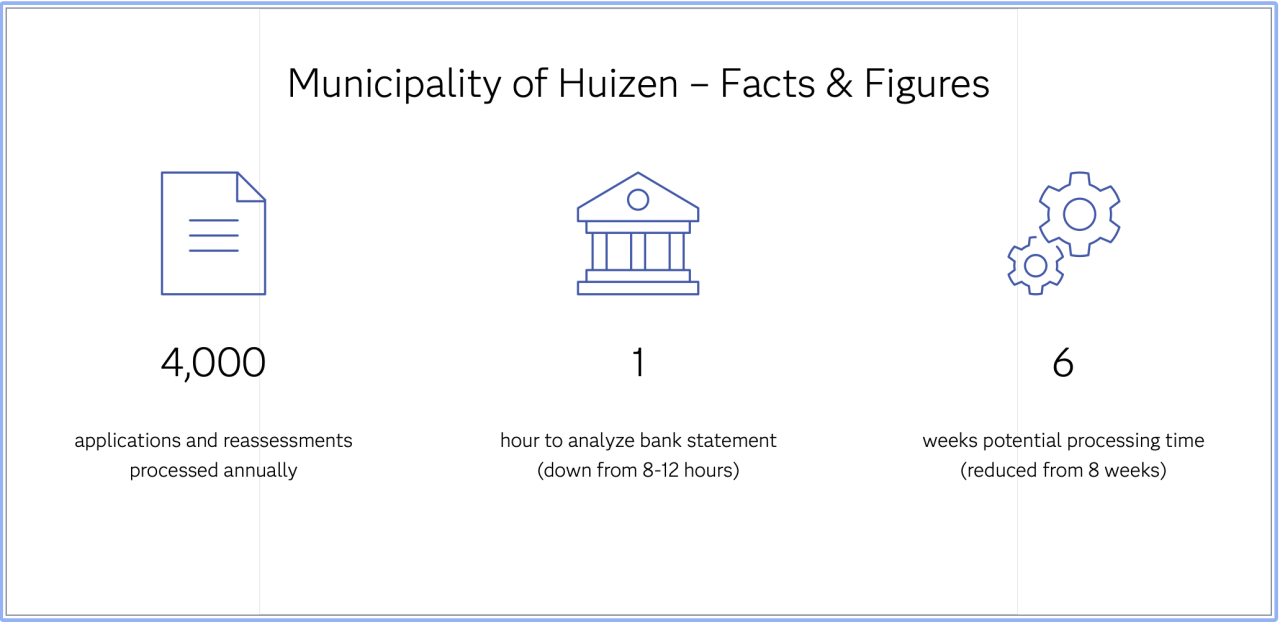
The Municipality of Huizen provides social services for its own residents and those in the neighboring municipalities of Blaricum, Eemnes and Laren, a region with approximately 70,000 residents. Each year, Huizen processes between 3,500 and 4,000 social assistance applications and reassessments. Like many local governments, the municipality needed better insight into social care spending, service demand and whether public resources were being directed where they could have the greatest impact.
''With analytics, we can use resources more efficiently and direct funding where it’s needed most''
Koen Buikema, Team Lead of Operations and Information Management Municipality of Huizen
Building a more data-driven approach
To improve visibility into those challenges, Huizen asked Koen Buikema, Team Lead of Operations and Information Management, to explore how the municipality could operate in a more data-driven way.
Buikema and his team began looking for ways to better analyze how support services were being delivered across programs. But they quickly encountered obstacles. Data was spread across fragmented systems, and inconsistent data quality made reliable analysis difficult. Before the municipality could benefit from analytics, it needed a stronger data foundation and more advanced capabilities. That’s when Buikema turned to SAS.
“From the very first introductory meeting, a whole new world opened up for us,” Buikema says. “SAS has so much knowledge and expertise in this field.”
Together, Huizen and SAS identified four priority use cases to explore how data-driven decision-making could improve outcomes across social services. The work quickly revealed an important challenge: the municipality’s underlying data was not yet reliable enough to support advanced analytics at scale.
“The technology immediately showed us where the quality of our data was falling short,” Buikema says. While two of the four initiatives did not initially produce the desired outcomes, Huizen viewed the experience as an important step forward. The projects revealed gaps in data quality, governance and organizational processes that first needed to be addressed to build a sustainable foundation for analytics.
“When something doesn’t work as expected, it becomes much easier to see what is still needed to build a data-driven organization,” Buikema says. “We follow a ‘fail fast, learn fast’ approach. It helps us identify the gaps we need to close so we can use data more effectively across the organization.”
Delivering more targeted support
One use case that yielded immediate results was with text analysis. “We used SAS Visual Text Analytics on SAS Viya to compare our policy plans with documents related to residents seeking support, to see whether the assistance we provide truly matches demand,” Buikema explains. The results challenged assumptions. “We discovered that many residents only need minor financial support and a small nudge to become self-sufficient again.”
In the past, Huizen relied on highly specialized financial experts for many of these cases. Now, local support teams can handle many of those situations directly, allowing specialists to focus on more complex cases. “With analytics, we can use resources more efficiently and direct funding where it’s needed most,” Buikema says.
This tool, deployed by SAS and Rotterdam-based Notilyze, a SAS partner specializing in managed analytics services, helps Huizen to respond more quickly. The municipality can accomplish more with the same number of staff because they are working more efficiently. The processing time for a welfare application could be reduced from eight weeks to perhaps six weeks.
Another insight emerged around families with gifted and/or autistic children. “We discovered that we were offering general support to families who needed specialized support, and vice versa,” Buikema says. “A single approach does not work for everyone; support should be customized to individual needs.”
Strengthening the foundation for data-driven services
For Buikema, the most important outcome was the broader understanding that the project created within the organization.
“SAS challenged us to think more strategically about what we can do with data and analytics,” he says. “SAS also helped us understand what it takes to become more data-driven. What standards do you need for data quality? How do you organize governance? What’s involved in developing analytical models – and then maintaining them over time? These early insights demonstrated how analytics could improve both efficiency and the appropriateness of care.”
About Notilyze
We are Notilyze, a SAS® Partner with only one goal: to help organizations with data analytics, and become more data-driven and successful. Our aim is to bring data analytics within reach of every department and every company. We do this by offering SAS® as a Service. Notilyze Cloud is the quickest solution to start with AI on SAS® Viya®. In addition, we offer IT solutions to properly integrate analytics into existing processes, and the experience of our SAS® specialists.
Want to learn more?
Please contact us!
// Contact
Notilyze B.V.
Stationsplein 45 A4.004
3013 AK Rotterdam
+31 (0)10 79 86 295
info@notilyze.com

